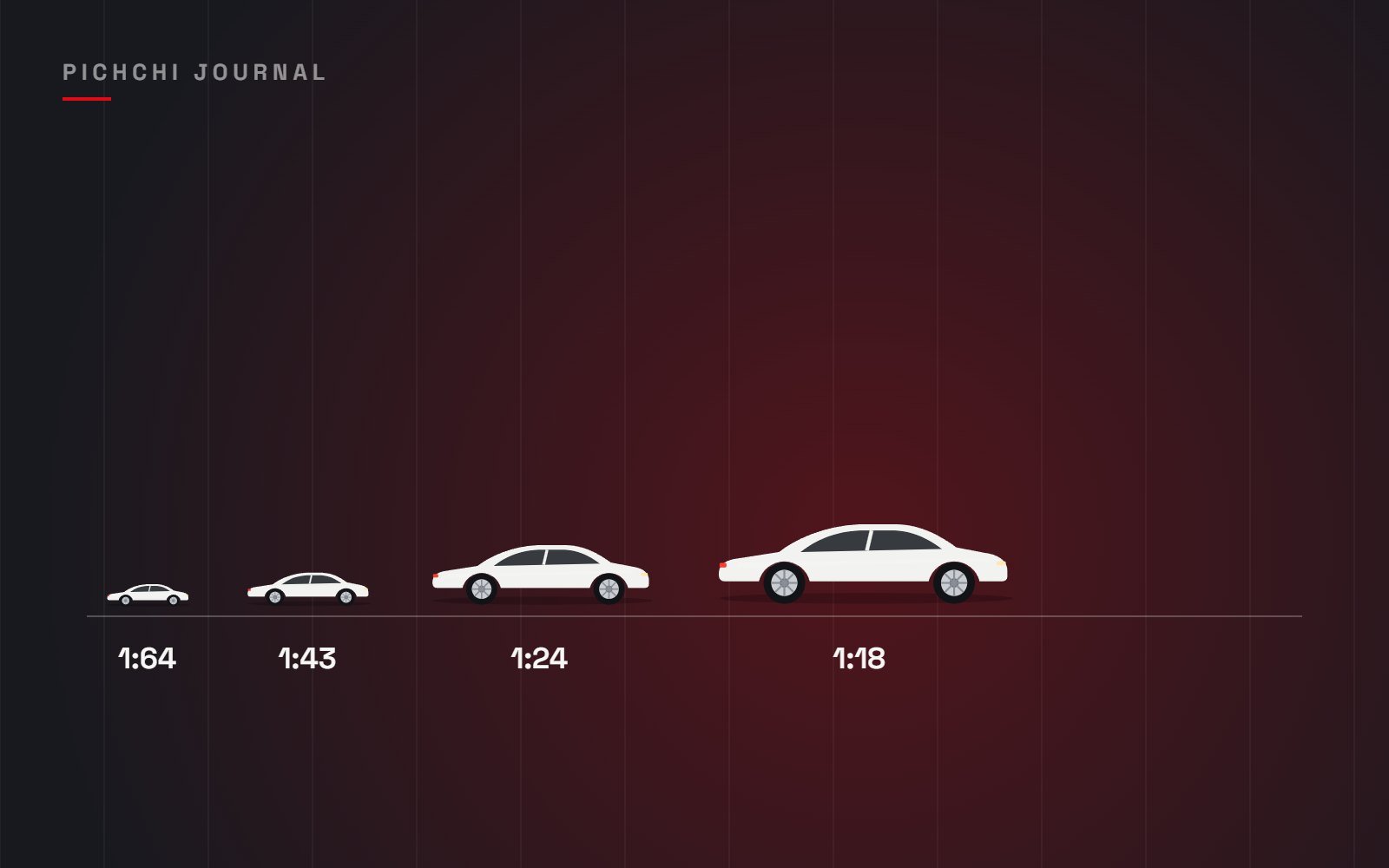
Every model car is labelled with a scale such as 1:64 or 1:18. The number tells you how many times smaller the model is than the real car. At 1:64, one centimetre on the model stands for 64 centimetres on the road.
How big is each scale?
| Scale | Typical length* | Good for |
|---|---|---|
| 1:64 | about 7 cm | Big collections in small spaces, the most popular scale today |
| 1:43 | about 10.5 cm | Classic collector scale, especially for European and racing cars |
| 1:24 | about 19 cm | Kits and larger display models |
| 1:18 | about 25 cm | Centrepiece models, often with opening doors and bonnet |
1:64: the pocket-sized favourite
1:64 is where most people start. Mainline toy cars sit roughly in this size range, though some are stretched or squeezed to fit standard packaging. Collector-focused makers such as Mini GT, Tarmac Works, Inno64 and Kyosho build 1:64 models with accurate proportions, rubber tyres and printed details, so a whole shelf of them still looks like a real car park.
1:43: detail without the bulk
1:43 has a long history with collectors, especially for racing cars and European classics. Models are large enough for fine detail such as mirrors, badges and interior parts, while a full collection still fits in a display cabinet.
1:18: the showpiece
At about 25 cm long, a 1:18 model is a showpiece. Many have opening doors, bonnets and boots, steerable wheels and a detailed engine bay. They take more space and cost more, so most collectors own a few favourites rather than hundreds.
Where should you start?
- Choose one scale for your main collection, so your models look right next to each other.
- If space or budget is limited, 1:64 lets you build a varied collection quickly.
- If you love one particular car, a 1:18 version makes a great centrepiece.
- Check the scale on every listing. At PICHCHI it is shown on each product.